
The Alcona County Owner of Record at a Glance
Alcona County's BS&A Online property search returns a basic result card. The card links an owner of record to a parcel number and situs. In the county's sample data, parcel 012-006-300-075-00 sits on Brook Trout Lane in Spruce. The owner string is carried on the tax roll. Deeper parcel detail may require an account, a claimed-property view, or paid access. Treat any fields beyond the basic card as available only when the live record shows them.
| Property Owner | The assessment-roll name attached to the parcel. |
|---|---|
| Mailing Address | The destination for assessment and tax notices, when exposed. |
| Situs Address | The physical location of the land, which may differ from mail. |
| Parcel Number | The stable cross-office key used to keep one tract in view. |
| Last Sale Date | A dated sale-history clue, if the detailed record exposes it. |
| Deed Reference | The instrument link to verify at the Register of Deeds. |
Remember what the roll actually identifies. It names the administrative owner of record, not an occupant. Mail may go to another home, a business office, or a registered mailing address. Copy every visible label. Note its year too. Do not reduce the result to a bare name.
The county sample illustrates how the portal lines up owner, place, and parcel context. Its BS&A parcel result is a useful model for reading the basic card.
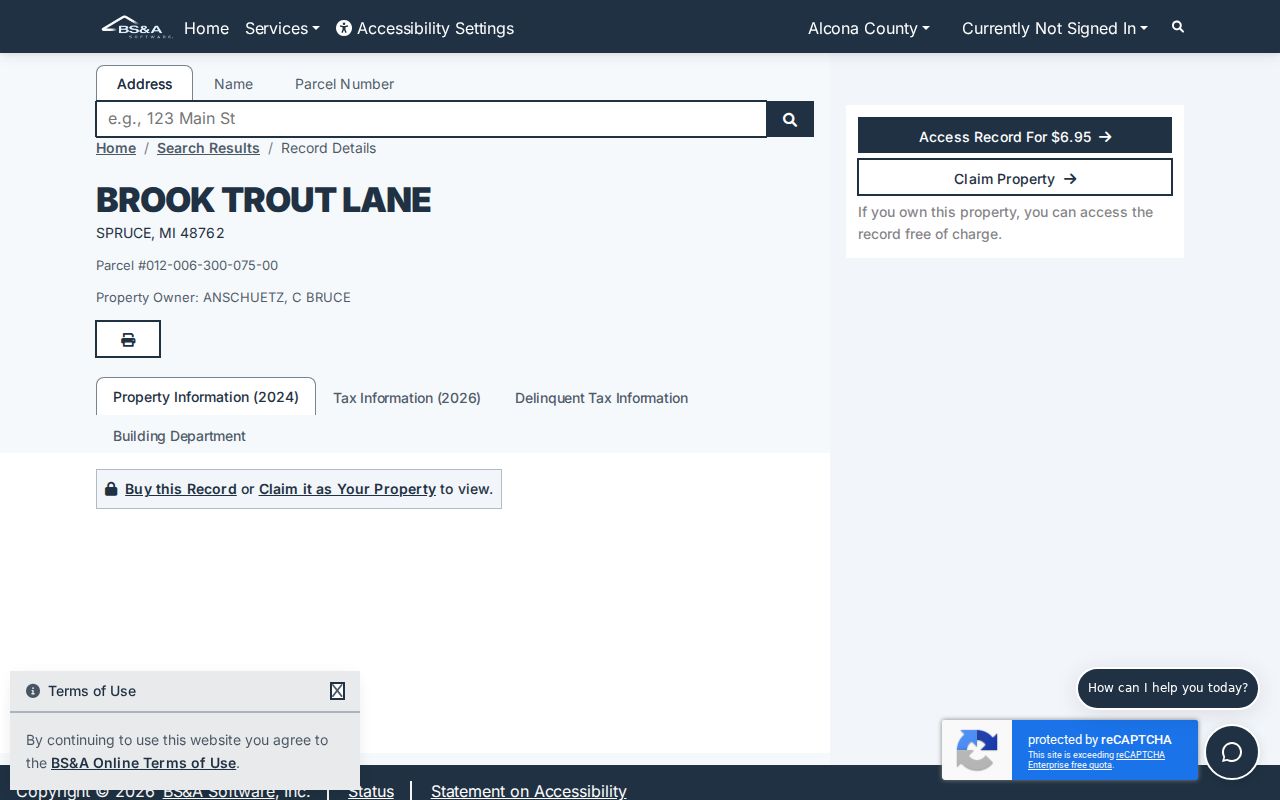
The screenshot also displays the detailed-record gate. That gate is a reminder: the public basic card does not always reveal mailing, sale, and value details on every visit.
Confirming the Current Alcona County Owner
A present-owner check starts with the roll. But it ends with the newest recorded conveyance when timing matters. Michigan requires a Property Transfer Affidavit after many transfers. Yet the deed and the assessment roll do not update at the same moment. Alcona County publishes no standard closing-to-roll delay. So avoid assigning a guessed number of days to any lag you notice.
- Search BS&A by situs address and record the exact Property Owner string and parcel number.
- Use Alcona County's named Laredo or Tapestry route to locate the most recent deed affecting that same legal description.
- Compare the deed's grantee, recording date, and property description with the roll.
- If the owner is an entity, check its state filing; if it is a trust or estate, do not guess at beneficiaries.
- Ask Equalization or the local assessor about an apparent lag, and ask the Register of Deeds about the recorded instrument.
- Owner of record
- The party named on the current administrative ownership record.
- Assessment roll
- The local record used to administer assessed and taxable values.
- Situs and mailing address
- The land's physical address and the separate place where notices go.
- Recording lag
- The interval in which a new deed is recorded but the roll has not yet caught up.
How Current Is an Alcona County Owner Record?
Two meanings of "current" are in play here. BS&A reports the owner used for assessment administration. The Register of Deeds keeps the sequence of recorded instruments. A freshly recorded deed can therefore be newer evidence than the roll, while an unsigned deal or pending closing is not a recorded transfer at all.
Recent-sale check. When the roll and newest deed disagree, note both dates and contact the offices; the recorded deed is the newer link in the public paper chain.
Keep the retrieval date in your notes. BS&A's vendor list says Alcona County has used the service since 2017. That is a client-service date, not proof that every ownership record begins then or refreshes on a fixed schedule.
Alcona County Mailing and Situs Clues
The situs answers one question. Where is the parcel? The mailing address answers another: where do notices go? Rural community names and postal addresses do not always match the local government unit that assesses the land. That gap is why the parcel number and legal description matter more than a city name in a ZIP line.
Alcona County's Building Department assigns new property addresses and forwards changes to 911, Equalization, USPS, and Consumers Energy. When an old deed will not match a modern street search, ask whether the address simply changed. Then search by parcel number or legal description instead.
Entity Names on the Alcona County Roll
An LLC, corporation, trust, or estate can appear where a personal name was expected. For a Michigan business entity, the LARA Corporations Division searches by entity name, associated individual, state ID, or filing number. The MiBusiness Registry Portal went live in June 2025. A registered agent serves as the entity's contact. That does not prove the agent owns the land personally. Trust terms and beneficiaries may stay private. Estate ownership can require probate-file context, while the deed itself still supplies the recorded vesting language.
Alcona County Offices That Resolve a Mismatch
Equalization sits at 106 5th Street in Harrisville. The office provides assessment rolls, section maps, land values, and local-assessor contacts. Its information-request route uses mgrieve@alcona-county.net, and the office page carries online payment instructions. Local assessing is distributed among townships and the City of Harrisville. Confirm the current assessor assignment before relying on an older roster.
The Register of Deeds works from the same courthouse address. Melissa Cordes's office answers at 989-724-9450, Monday through Friday. Hours run 8:30 a.m. to 4:30 p.m., closing from noon to 1 p.m. The office records documents. It does not prepare them or give legal advice.
Recorded Notice for an Alcona County Owner
Alcona County takes part in a free Property Fraud Alert service. Enrollment can deliver phone, text, or email notice. A notice goes out when a document is recorded in a subscribed name. The service is a watch tool only. It does not block a filing or judge a deed's validity. It also does not replace review of the actual instrument. Name matching can also trigger harmless alerts. Compare the document, parcel, legal description, and recording details before drawing any conclusion. Then call the Register of Deeds if the filing is unfamiliar.
When BS&A Details Are Not Visible
The parcel card in BS&A hides its most detailed layer behind a $6.95 fee. A resident account can claim up to five properties at no charge. That gate is a vendor choice. It is not an official copy fee. There is no promise every parcel shows the same fields.
When the ownership detail stays out of view, ask Equalization for the exact roll field. The local assessor can supply it too. A Michigan FOIA request works as well. Put the parcel number, address, field, and date range in writing. The public body usually answers within five business days. It can extend by up to ten more with a written notice. It never has to create a record that does not exist.
Lawfully Reaching an Alcona County Property Owner
A letter is the sound first move when a public mailing address is on display. Keep it concise. State the boundary question, easement concern, sale inquiry, or other shared property issue plainly. Give the owner a clear way to reply. Some qualifying Michigan residents rely on the Safe at Home Address Confidentiality Program. It substitutes a mailing address for safety reasons. That substitute address should never be read as proof of where someone actually lives. Send correspondence there without drawing conclusions from it.
Lawful use. Public owner information supports legitimate property matters. It must never be used to stalk, harass, intimidate, or evade an address-protection measure.
A present-owner check is not a title opinion. For a purchase, an estate, or a contested interest, pull the recorded instruments and use qualified legal or title help.