
Start an Alcona Records Search
BS&A Online is the best first stop. Its county page opens doors to assessing, current tax, delinquent tax, and building records. Search by address when you know the site. Search by owner when the name is stronger. Use a parcel number when you hold the exact key. Write down the parcel number, situs, owner label, local unit, and legal description before you move on.
From there, match the office to the question. The Register of Deeds handles ownership and encumbrances. The Treasurer tracks delinquent tax and payment history. The GIS adds geographic context, and the state plat system covers subdivisions and survey language. Each record exists for a different public task, so agreement between systems strengthens a finding. Still, no public lookup becomes a title opinion or a survey.
- Find the parcel in BS&A by address, owner, or parcel number.
- Carry the owner and land clues into Tapestry or Laredo for recorded instruments.
- Check the correct assessment and tax year, including delinquent status where relevant.
- Compare the GIS, section map, plat, and deed description for location questions.
- Request missing or certified records from the office that keeps them.
Alcona County Record Custodians
Record custody is unusually centralized here. The Register of Deeds, Equalization Department, and Treasurer all work from the county courthouse at 106 5th Street in Harrisville. City and township assessors still handle local assessment duties, while Equalization maintains the rolls, section maps, land values, forms, and the assessor roster. Call ahead before visiting. Confirm the right desk, staff contact, and copy procedure.
Alcona County Register of Deeds
106 5th Street, PO Box 269
Harrisville, MI 48740
989-724-9450
Alcona BS&A Parcel Records
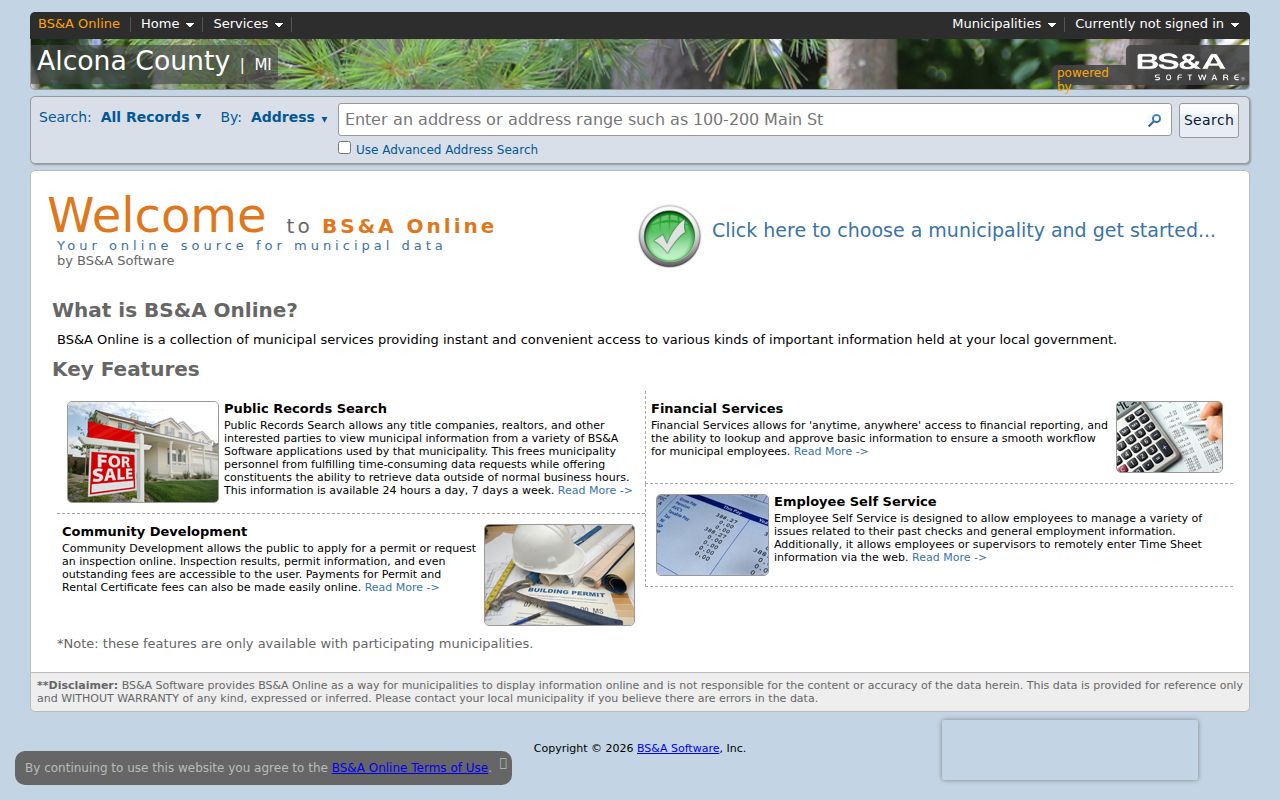
BS&A serves as the county's main address, name, and parcel-number lookup. Its landing page splits into Assessing Search, Building Department Record Search, Delinquent Tax Search, Pay Delinquent Taxes, Detailed Record Search, Pay a Bill, and Current Tax Search. The vendor lists the county as a client since 2017, though that date only marks service, not the start of the records themselves.
The official county portal displays these categories before any search begins. Pick the one that matches your year and question. Treat each value on its own terms rather than blending them into a single figure.
A detailed record costs $6.95. Free access follows once a resident account claims up to five properties. Access terms can change without notice. Basic results still return the parcel key an office needs for a records request. An observed sample parcel result shows the address. It also shows the parcel identity beside the gate for paid or claimed-property detail.
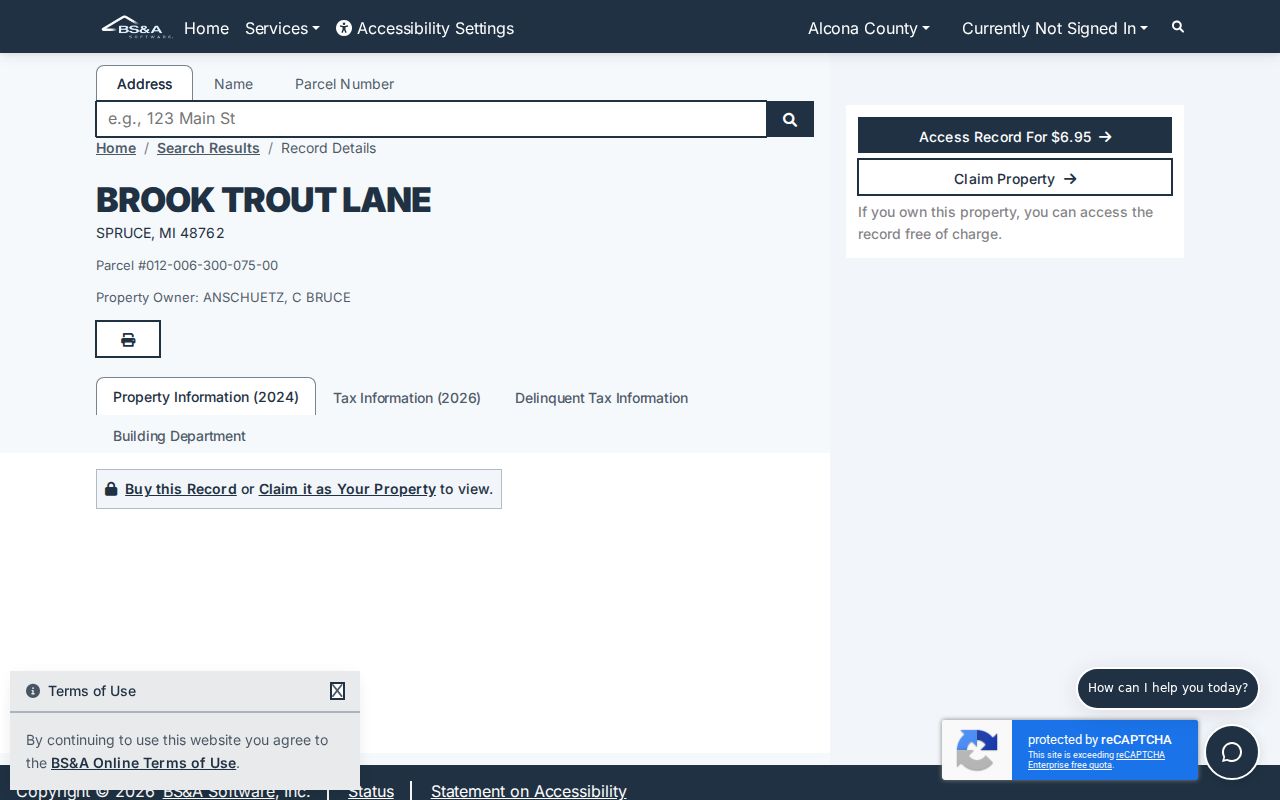
The split is clear on that screen. A basic match gives plenty, while some fields sit behind added access.
Alcona Property Record Types
No single record answers every question in Alcona County. Deeds document transfers of ownership. Assessment records back valuation and taxation, and tax accounts show billed or delinquent amounts. Parcel and plat sources describe the land itself. Permit files capture proposed or inspected work, while courts hold foreclosure, quiet-title, and lien disputes.
| Record Type | What It Documents | Kept By | Access |
|---|---|---|---|
| Deeds and land contracts | Transfers and recorded ownership trail | Register of Deeds | Tapestry, Laredo, counter, mail |
| Mortgages, liens, releases | Recorded claims and discharged interests | Register of Deeds | Portal or office request |
| Assessment and tax | Owner label, values, PRE, bills, delinquency | Local assessor, Equalization, Treasurer | BS&A and office |
| Plats and parcels | Lot, section, survey, and map context | County, Register, Michigan LARA | GIS, Accela, office |
| Building permits | Applications and improvement records | County Building Department | Forms and office request |
Choose the record that fits the task. Alcona County deed records carry the recorded paper chain of title. The tax page fits questions about a tax year, assessment, exemption, delinquency, or appeal. Boundary questions call for the deed's legal description. Survey evidence matters there too. A web map line alone proves little.
Alcona Deeds Through Tapestry
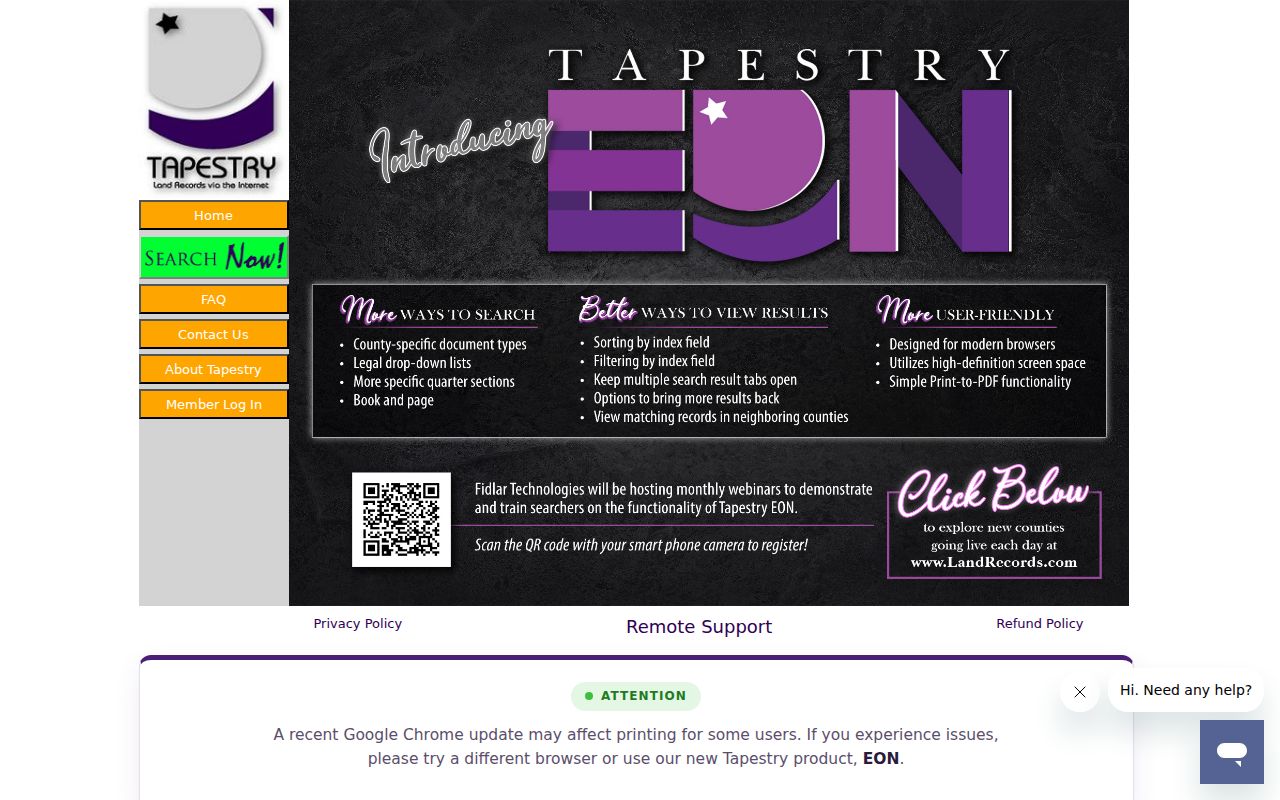
The county names Tapestry for occasional fee-based deed searches and Laredo for subscriptions. The Register of Deeds page states no online index start year, image cutoff, field set, or result limit. A blank result online therefore proves nothing about whether an older instrument was recorded.
The Tapestry search screen is the county's designated entry point. Start with grantor and grantee names, an approximate date, and a document type. Then compare each result against the property description before trusting the match.
Missing a year or an image? Call 989-724-9450 or request the record at the Harrisville office. Ask for the document itself, not a legal judgment on title.
Alcona Parcel and Plat Sources
The official county GIS runs on a Beacon/Schneider viewer. Its interactive endpoint returns HTTP 402, so local layers, imagery dates, and export options remain unconfirmed. Michigan DTMB confirms counties maintain tax parcel data and links to each county access point.
When the viewer fails, other sources work well. Equalization section maps, BS&A, deed descriptions, and the Michigan Accela plat search all help. Accela searches by County, Subdivision Name, Section, and Quarter. It also covers Town, Range, Index Code, Private Claim Number, and date. Those fields can locate land when no current address exists.
Alcona Assessment and Tax Records
Equalization supplies assessment rolls, section maps, land values, property-search links, forms, and local assessor contacts. Its 2023 report counted 19,845 assessment parcels or units countywide. That figure is not a population count, building count, or tally of taxable homes. Keep the report year and unit label attached whenever you use it.
The county BS&A tax entry separates search from payment functions. Before relying on any amount, check the tax year. Also check the current or delinquent status. Confirm the retrieval date too.
The Treasurer manages delinquent taxes, tax-history requests, payments, tax certificates, and public-land-auction details. A "tax sale" label alone never proves the county conveyed the parcel.
Alcona Assessment Forms and Appeals
Alcona County publishes its assessment paperwork through the Equalization forms directory. Land divisions, property combinations, and lot-line adjustments all live there. So do Principal Residence Exemption claims, transfer affidavits, Board of Review petitions, and qualified-agriculture forms. Filings like these shape the assessment trail. They cannot change a deed's legal description. They cannot establish who owns a property in Alcona County either. The directory page itself displays the county's assessment and Board of Review entry point.
For deadlines and local assessment questions, work with the responsible city or township assessor. That office handles them, not the county. It saves time.
State rules draw clear lines between assessed value, state equalized value, taxable value, and the Principal Residence Exemption. Each field answers a different tax question for an Alcona County parcel. The distinction matters when a tax bill looks off. It also shapes an appeal.
The Equalization Department overview identifies the rolls, maps, and land-value resources. Alcona County maintains these for property records.
Use that county layer to locate the right local assessor. Equalization supports the process, but it does not replace city or township assessment work in Alcona County.
Alcona Historic Property Clues
Older clues about a house or site often lead beyond the deed index. The Archives of Michigan finding aid lists a 1938-39 Rural Property Inventory under RG 84-33. It can connect a building, place, or owner-era detail to older land records. The Alcona County Review newspaper run starts April 27, 1877. It extends through the latest complete year the historical society reports. Estate notices, vanished community names, and land-sale context frequently surface in those pages. Treat newspapers, archives, and library holdings as leads only. Ownership should be confirmed through recorded deeds. Probate files, court orders, and other primary property records also work. Before visiting, ask staff whether a volume survives on paper, film, or another format. Also ask whether any gaps exist.
Survey evidence opens another route. Michigan's spatial library holds General Land Office plats and county land-corner certificates. One local remonumentation certificate was filed in Alcona County records. It sits under a liber and page reference. A corner record helps explain the survey framework beneath a parcel. Still, it must be reconciled with the deed description and current professional survey work.
Alcona Property Fraud Alerts
Alcona Property Fraud Alert notifies enrolled owners when a new recording matches their name. The county has offered the service since 2020. A March 2025 local report put enrollment below one-third of county owners. That is a striking gap for deed protection. The signup screen displays the county choice and the free enrollment route. Register any useful name variants, then check any alert against the recorded instrument itself.
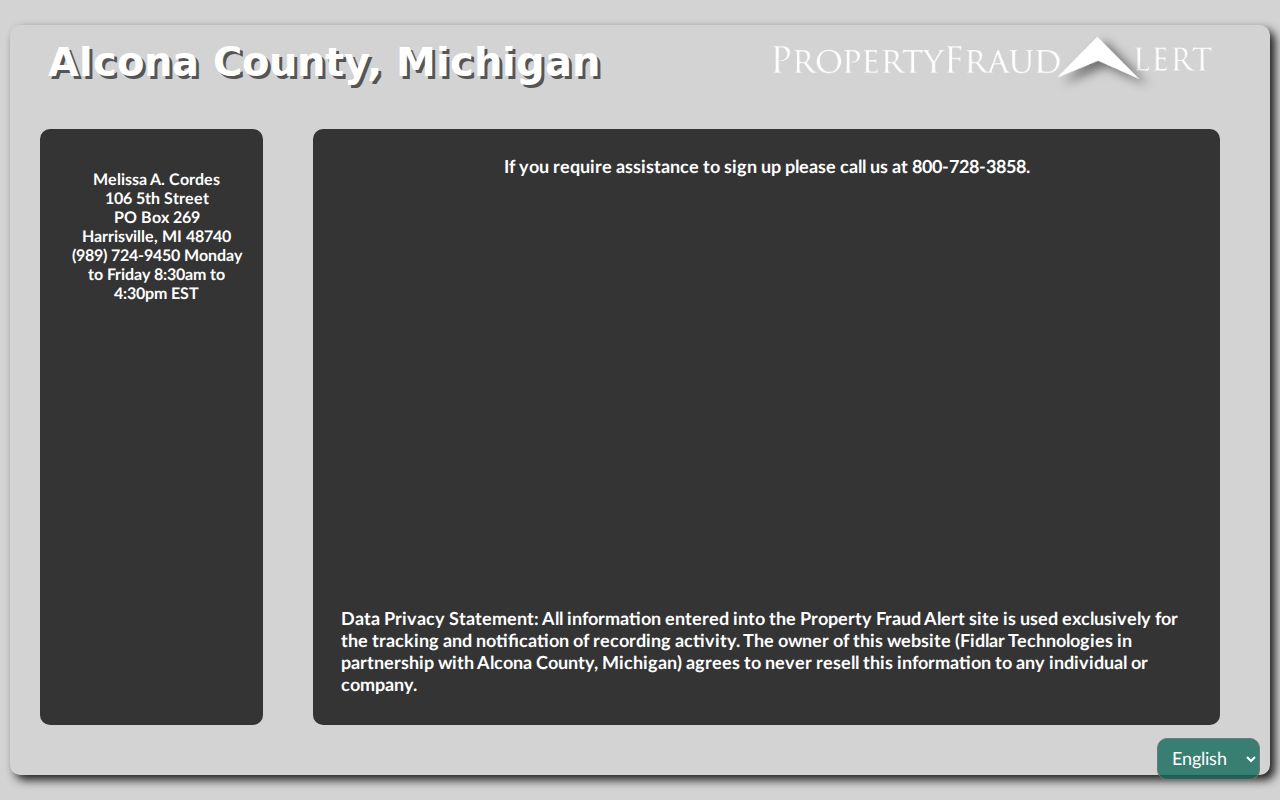
An alert does not block a recording. Nor does it validate title. Contact the Register of Deeds about an unfamiliar notice, and seek legal advice if ownership rights could be affected.
Alcona Property Cases in Court
Property disputes in Alcona County land in the 23rd Circuit Court or the 81st District Court. Jurisdiction decides the channel. Foreclosures, lien enforcement, and quiet-title cases all travel these channels. MiCOURT Case Search provides party-name and case access. Each court sets its own scope, and some categories stay nonpublic.
A docket entry only proves an event was recorded. It does not replace the complaint, order, judgment, sheriff's deed, or later Register of Deeds filing. When the outcome touches a property question, pull the underlying document.
Probate Court handles estates, trusts, guardianships, conservatorships, and small estates separately. An estate file may explain the authority behind a fiduciary deed. It may also explain why a recorded chain skips a normal sale. The Archives finding aid reports an Alcona probate index covering 1893-1983 plus a calendar for 1947-1983. Those dates describe archival series, not current online case-image coverage.
Alcona Building Record Routes
The Alcona County Building Department posts building, electrical, mechanical, and plumbing permit forms. It offers no public searchable permit-history database. A parcel-based office request remains the sound route for older permits or inspections. Include the owner or applicant name, parcel number, situs address, local unit, project type, and an approximate date. Do not assume the current BS&A building-search label exposes the full paper file.
January 2026 county minutes approved a revised building fee schedule. It takes effect February 2, 2026. The schedule includes reported solar plan-review minimums. The minutes capture one policy change, not a complete fee inventory. Confirm the current charge with the Building Department before filing. New address work also moves among 11, Equalization, USPS, and Consumers Energy.
Harrisville and Alcona Record Geography
Harrisville is Alcona County's only incorporated city. Lincoln ranks as a village. Many familiar community and ZIP names describe rural postal geography rather than any city boundary. A destination called Harrisville can sit outside the city, including spots in Harrisville Township. Check the parcel record for the taxing and zoning unit. Route permit, assessment, and planning questions accordingly.
County systems still anchor Harrisville records for deeds, Equalization, tax, GIS, and much building work. The city separately runs its own assessor, planning, zoning, and complaint channels. The 2023 Equalization report counted 460 city assessment parcels. The 2020 Census counted 437 residents. Those figures measure different things. One tallies assessment units in a report year; the other counts people.
Limits of Alcona Property Records
Alcona County property records answer many questions. They show the roll owner of record and the recorded grantee on a deed. They also show assessed and taxable values, and whether a tax bill is paid. A parcel number unlocks the legal description, plat details, and permits. It also opens any encumbrances filed against the land.
The records have real limits, though. Not every interest gets recorded. A tax parcel line on a GIS map is not a surveyed boundary. An assessor's appraisal rarely matches a sale price. A mailing address on the tax roll does not prove that anyone lives there.
Some data is lawfully withheld. Michigan's Address Confidentiality Program gives eligible survivors a substitute address and mail forwarding. Public access never licenses anyone to target, stalk, or harm a person. Owner data serves honest purposes. These include purchase research, estate work, boundary review, tax matters, and civic transparency.
Lawful use. Alcona County property records support legitimate property research. They do not replace a title professional or licensed surveyor, and they must never be used to harass anyone.