
What an Alcona County Property Value Means
One word, several numbers. Michigan assessment records keep them apart. Alcona County Equalization supplies rolls and land values, local assessors handle the assessment work, and the Register of Deeds holds conveyances that may carry separate sale evidence.
| Value Type | What It Means | Where It Is Recorded |
|---|---|---|
| Assessed value | Michigan assessment figure set at about half of true cash value | Assessment roll and BS&A detail |
| State Equalized Value | Assessed value after equalization | Assessment record |
| Taxable value | A separate capped tax-base figure that may be lower | Assessment and tax record |
| Last sale price | Evidence from a past transaction, not a present estimate | Deed or transfer documentation; sometimes roll history |
Michigan's assessment level sits near fifty percent of true cash value. Doubling an assessed figure hints at that basis. The arithmetic is not an appraisal. Taxable value follows its own cap and transfer rules. For the current roll, the Alcona County BS&A landing page is the practical starting point.
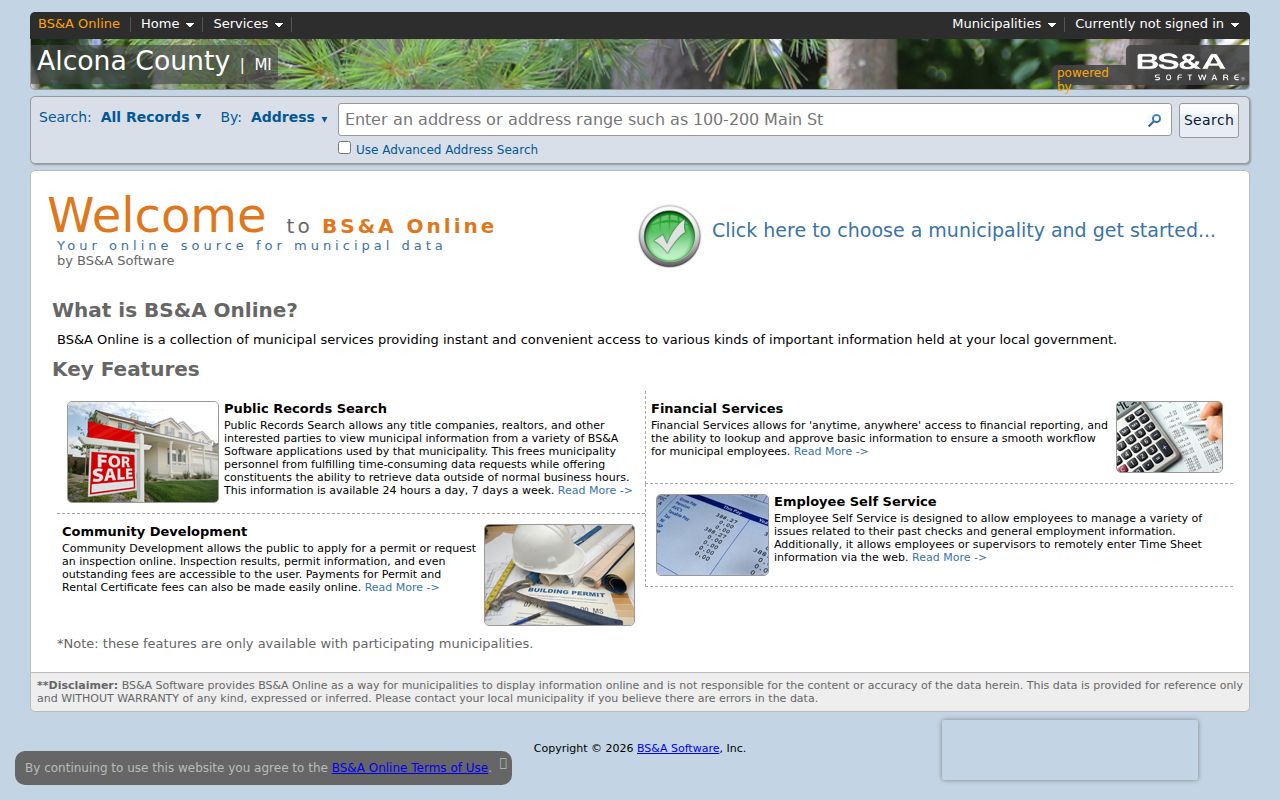
The portal offers assessing and tax modes. Deeper fields may require an account, a claimed-property view, or paid access.
Where Alcona County Property Values Are Recorded
Search by address first. Then save the parcel number so the same tract can be traced across offices, and copy every value with its tax year and exact label.
- Search the situs in BS&A; if needed, switch to parcel number.
- Open the assessing record and copy assessed value, SEV, taxable value, and year if exposed.
- Record land and improvement components only when the live detail labels them.
- Check the recorded deed for separate consideration or transfer evidence.
- Ask the local assessor or Equalization to explain a field or supply a value history.
- Assessed value
- The valuation figure used before equalization, not the same as taxable value.
- Market or true cash value
- The assessment concept for the property's cash value, not a sale guarantee.
- Assessment ratio
- The relationship between assessed and true cash value, approximately 50 percent in Michigan.
- Sale or consideration price
- A transaction figure tied to a past conveyance.
- Reassessment
- A new determination of assessment facts for a tax year.
Michigan's 50 Percent Level in Alcona County
In Alcona County, assessed value and State Equalized Value sit at roughly 50 percent of true cash value. Michigan sets that ratio statewide. It is an assessment framework. It is not a promise that a buyer will pay double the assessed figure.
A sale price is not automatically treated as true cash value under MCL 211.27(5). Market conditions and the condition of the property can both push an actual purchase away from the number on the tax roll. The terms of the deal matter too. So does the valuation date.
Taxable Value Is a Different Alcona County Number
Taxable value can stay below SEV. Michigan caps its growth until a transfer or another statutory event changes the treatment. A transfer usually uncaps it the next calendar year, subject to exceptions under MCL 211.27a. Two similar parcels can therefore carry similar assessed figures but different taxable values. That lower number is not a lower market appraisal. It does not prove a sudden gain in worth. The change came from the cap, not the market.
Sale Price in an Alcona County Deed Record
A deed's last sale is a dated data point. Check the recorded conveyance for consideration or transfer-tax evidence. Keep that separate from any sale-history field in BS&A. Online parcels may not display identical sale fields. The Alcona County Register of Deeds records deeds and land contracts at 106 5th Street in Harrisville. Its index start is not published. Call 989-724-9450 if a sale record does not surface online.
PRE Does Not Set Alcona County Market Value
Michigan's Principal Residence Exemption can exempt up to 18 mills of local school operating tax on an eligible principal home. PRE changes tax treatment only. It does not set price or title. Nor is PRE proof of occupancy. Poverty exemptions work similarly, reducing an assessment obligation in set percentages under state policy. Relief changes the tax bill, not the parcel's condition or open-market price.
Harrisville's Dated Value Trend
Harrisville planning material reported about $20.35 million in assessed value and $18.98 million in taxable value for 2022. The source also traced a 2017-to-2022 trend. Those are citywide, dated totals. They can't set a value for one home. The city assessor page links 2025 land and economic-condition-factor studies covering streets, lake and dock areas, Main and Huron corridors, and acreage sizes. Study categories explain mass assessment, but they never replace inspection of a single parcel.
Requesting an Alcona County Value History
Equalization holds the assessment rolls and land values. Local assessing sits with the townships and the City of Harrisville. When asking, request the parcel number, the named value fields, the tax years, and any land and improvement split. Confirm the current assessor assignment first. County and city pages list conflicting Harrisville contacts. A narrow Michigan FOIA request can seek existing rolls. A public body usually responds within five business days and can extend up to ten more by written notice. It may charge authorized costs, but it need not create a custom appraisal or answer a valuation question.
Comparing Alcona County Values by Year
Build a simple series, one row per tax year. Give each value its own column, with separate entries for assessed value, SEV, and taxable value. Add land and improvement components only when the record labels them. Never mix a citywide total, a parcel figure, and a sale price in one trend line, because each measures a different unit or event. Each measures something distinct. Note transfers and assessment changes beside the numbers. But timing alone does not prove causation. A building change, classification issue, equalization adjustment, or corrected record may explain the shift, and the responsible assessor can walk through the administrative record with you.
What an Alcona County Property Value Does Not Tell You
An Alcona County assessment is a mass-appraisal figure built for tax administration. It carries no promise about what a sale might bring. The number will not itemize repairs, settle a boundary dispute, or stand in for a date-specific opinion from a qualified appraiser, and a GIS parcel polygon adds no value at all by tracing a shape.
Value versus price. An Alcona County assessed value is not what the property will necessarily sell for, and the public roll is not a private appraisal.
For exemptions, appeal procedures, and the details behind a tax bill, the Alcona County property tax records guide goes further. This page sticks to what each value figure actually means.