
Tracing Former Alcona County Property Owners
Start with the most recent deed. Arrange each earlier transfer below it, working from the newest conveyance back through the deed records. That order keeps an Alcona County ownership chain easy to follow. For document access, the county points researchers to Tapestry for pay-per-document searches. Laredo serves subscribers who need heavier use. The county itself publishes no online index. No image start year can be stated, so a careful timeline simply notes what each recorded instrument shows without guessing at coverage dates.
| Transfer Date | Grantor to Grantee | Deed Type | Book/Page or Instrument |
|---|---|---|---|
| Newest first | Seller to present grantee | Warranty or quitclaim | Copy the exact reference |
| Prior transfer | Earlier seller to later seller | Deed or land contract | Match the same land |
| Estate interval | Fiduciary to successor | Deed or court order | Cross-check probate |
| Historic link | Earlier named parties | Deed-book entry | Ask for liber and page |
Mortgages, releases, liens, and easements can shape a title without ever making their parties prior owners. Classify the instrument before anyone joins the chain. The county Register of Deeds page is the official word on search routes and record types.
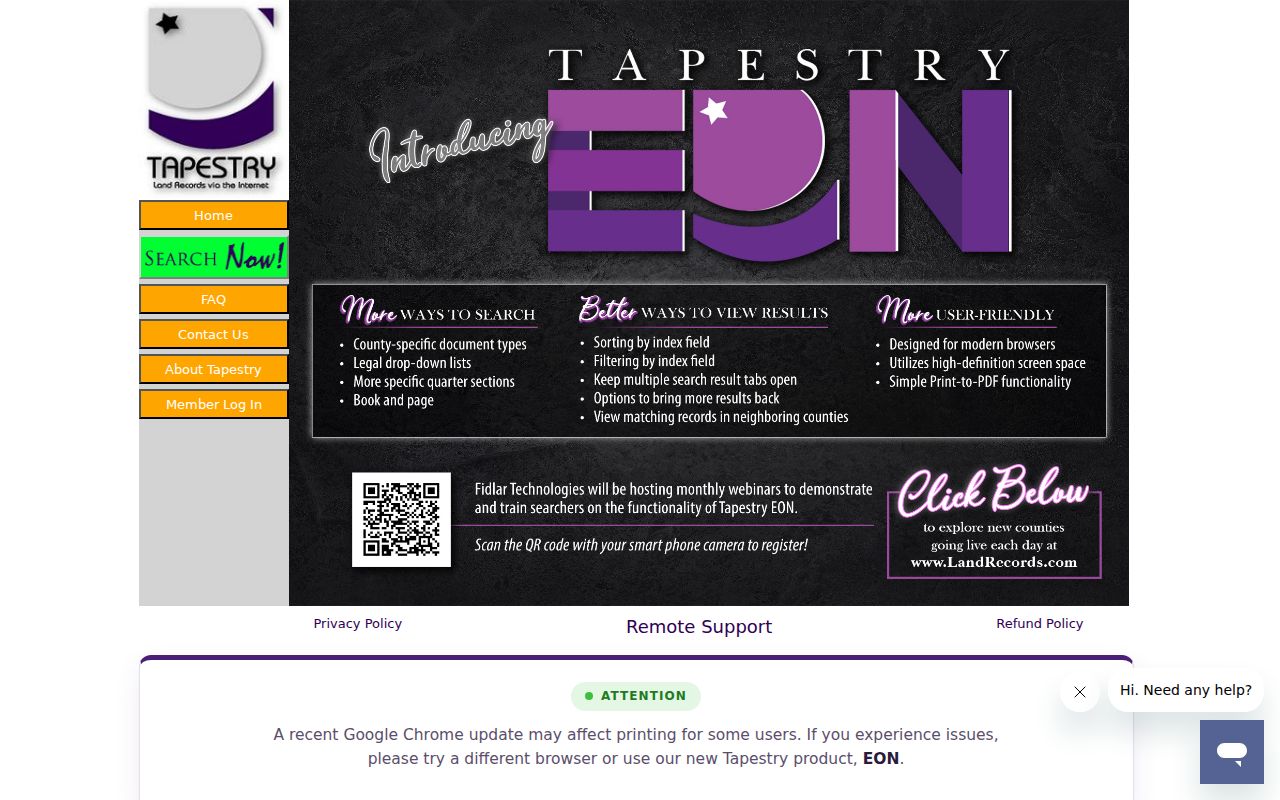
A Tapestry screen only opens a search route. The next link in an Alcona County deed chain comes from a matched legal description and a dated instrument.
Reading an Alcona County Deed Chain Backward
Read each deed for its roles. The grantee received the stated interest, and the grantor conveyed it. At every earlier link those roles reverse while the property description stays fixed.
- Find the present grantee's acquisition deed and note its recording date and land description.
- Copy the grantor name exactly, including initials, suffixes, and entity terms.
- Search that grantor as an earlier grantee to locate the prior acquisition.
- Match parcel context, description, and date sequence before accepting the result.
- Repeat until online coverage stops, then request the earlier index and books.
- Grantor and grantee
- The conveying party and receiving party named by an instrument.
- Chain of title
- The ordered run of recorded interests affecting the same land.
- Reverse index
- An index used to find a party in the receiving role.
- Quitclaim and warranty deed
- Different conveyance forms whose legal effect cannot be decided from the label alone.
Alcona County's Unpublished Online Cutoff
No authoritative local source names the first searchable deed year or the first online image year in Alcona County. Access through Laredo and Tapestry does not prove that every historic liber is indexed or imaged.
Coverage check. Ask for the earliest grantor-grantee index, deed-book ranges, microfilm holdings, and image availability before choosing a stopping year.
Melissa Cordes's office sits at 106 5th Street, PO Box 269, Harrisville, and answers at 989-724-9450. Hours run weekdays, 8:30 a.m. to 4:30 p.m., closing noon to 1 p.m.
Earlier Alcona County Ownership Sources
When online results run dry, keep going at the Register of Deeds counter. Ask there about historic indexes, deed books, and microfilm. The Library of Michigan and the Archives of Michigan can help, and the Alcona County Library serves as a fallback too. Confirm their holdings before any trip or request.
The Archives county guide lists a Rural Property Inventory covering 1938 to 1939. That inventory adds historical land and building context. A recorded conveyance still governs the chain.
Alcona County Plats Bridge Old Addresses
Street labels and rural mailing communities shift while survey descriptions endure. Alcona County spans ranges 5E through 9E and townships 29N through 32N. Section, town, range, subdivision, lot, and block clues all help. They can tie an old instrument back to a modern parcel.
Michigan's Accela plat search offers many fields. They include County, Subdivision Name, Section, Quarter, Town, Range, Index Code, and Private Claim Number. Use a recorded plat for context. Then compare the deed description. A generalized map line never substitutes for survey proof.
Probate Breaks in an Alcona County Chain
A death can break a simple buyer-seller pattern. So can a fiduciary deed, court order, land contract, or unrecorded family arrangement. The Archives guide lists an Alcona probate index from 1893 to 1983. It also lists a calendar from 1947 to 1983. Those aids point toward case files. They do not transfer title themselves.
Mortgage assignments and discharges also shift lien relationships. They do not turn a lender into a previous owner. Keep encumbrances on a second list so the owner timeline stays clean.
Name Variants Among Prior Alcona County Owners
Search every way a name appears. Try initials, suffixes, married names, spelling variants, and entity-name changes found in the documents. County assumed-name certificates can explain why a trade name differs from a deed party. Michigan business filings can also explain it.
A matching name alone proves nothing. Weigh the legal description, spouse references, dates, and surrounding index entries. Harrisville incorporated in 1905, yet its deed records stayed county-held. The municipal label changes context, not custody.
Newspaper Clues to Former Alcona County Owners
The Alcona Historical Society reports an Alcona County Review run at the county library. The run starts April 27, 1877. It continues through the latest complete year. Lincoln Herald and Alcona County Herald holdings exist too, with gaps. Estate notices, sales, plats, and court notices can yield search names and dates.
Treat each newspaper item as a lead only. Use it to narrow a deed, probate, or court request. Then confirm the transfer in the official record.
Copies and Notes for an Alcona County Timeline
Build a citation sheet as you go. List party names exactly as indexed, execution and recording dates, deed type, legal description, and the book, page, or instrument number. Add a source-access date. Note whether each image came from a portal, a counter copy, or an archival holding. That discipline lets you revisit a weak link without repeating the whole search.
Copies cost $1 per page at the Register of Deeds, with $5 added for certification. A mailed request should include a self-addressed stamped envelope. Those fees cover the requested record, while a portal may set separate access terms. Ask the office for the exact total. A plain screen image is never a certified copy.
Testing Each Former Alcona County Owner Link
A name chain that looks complete can still skip between two different tracts. Alcona County deed research rewards skepticism. Test every row against acreage, lot and block, and the section-town-range description. Check spouse and entity language too. The next deed's recitals often confirm or expose a break.
Label your uncertainty when the property description shifts. Do the same if a probate interval is missing. Flag it too when an address refuses to reconcile. A quitclaim that conveys only one person's interest did not necessarily move the whole fee. A title professional can judge legal continuity where the property records leave room for doubt. Treat the timeline as a well-sourced history, not insurance against a misindexed or undisclosed interest.
How Far Back Alcona County Ownership Records Go
Alcona County began as Negwegon, set aside in 1840. It was renamed in 1843 and described as incorporated in 1869. Those dates frame the county's history. But they say nothing about the earliest surviving deed in the recorder's holdings. Federal GLO plats and field notes add early survey context to Alcona County ownership records. Though they prove nothing about current owners of record.
Lawful use. Research former owners for house history, estate work, and property diligence. Never use a chain to track, threaten, or harass a living person.
No authoritative account of a courthouse fire or lost records exists for Alcona County. Document the sources and years you searched rather than blaming an unexplained gap on a disaster.