
Inside Alcona County Property Tax Records
No single document holds Alcona County property tax records. The work is layered across three levels. The local assessor builds the assessment record for each parcel. County Equalization keeps the assessment rolls, section maps, and land-value material that support those numbers, while the Treasurer owns delinquent tax, tax histories, and the public land auction. Always check the year attached to a value. Current assessed value, State Equalized Value, taxable value, and a prior sale amount can all differ legitimately, and only the label tells you which one you are reading.
| Field | What It Shows | Where |
|---|---|---|
| Assessed value and SEV | The assessor's estimate and equalized figure, generally near half of true cash value | Local assessor / Equalization |
| Taxable value | The capped value used in the tax calculation, subject to transfer rules | Assessment roll / BS&A |
| PRE status | Whether the Principal Residence Exemption affects school operating tax | Local assessor |
| Current or delinquent tax | Tax year, charge, payment, balance, and delinquency stage when available | BS&A / Treasurer |
| Tax history | Prior-year amounts or payment research requested for a parcel | County Treasurer |
A recorded purchase price is not the true cash value under Michigan law. The tax bill is not a sale appraisal either. Note the parcel number, tax year, retrieval date, and whether each figure is assessed, equalized, taxable, paid, or delinquent before relying on it.
Use Alcona County's BS&A Tax and Assessing Tools
Alcona County runs its tax and assessing lookups through the official BS&A portal. The service tiles include Assessing Search, Current Tax Search, Delinquent Tax Search, and Pay Delinquent Taxes. Other tiles offer Detailed Record Search and payment options. The basic property search takes a name, address, or parcel number. A typical result shows the street address, city and ZIP, and parcel number. It also lists the property owner, with full detail gated behind further access. Do not assume every record exposes the same history or fields.
| Control | Verified use | Important limit |
|---|---|---|
| Search scope | All Records, Assessing, or Tax | Exact year depth is unpublished |
| Name | Owner-name property search | Matching rules were not stated |
| Street address or range | Single address or street-number range | Advanced local fields were not verified |
| Parcel number | Direct parcel lookup | No official format guide was located |
| Current/delinquent tiles | Tax search and payment entry | No local tax-result sample was publicly verified |
The county has appeared on the BS&A client list since 2017. That date does not prove the assessment or tax archive begins in 2017. Confirm historical coverage with the responsible office before counting on older records.
Note: An observed detailed parcel record cost $6.95, while a resident account could claim up to five properties without charge.
The county's official tax-search landing screen lays out the service tiles so you can pick a search mode with confidence. View the Alcona County BS&A tax search source.
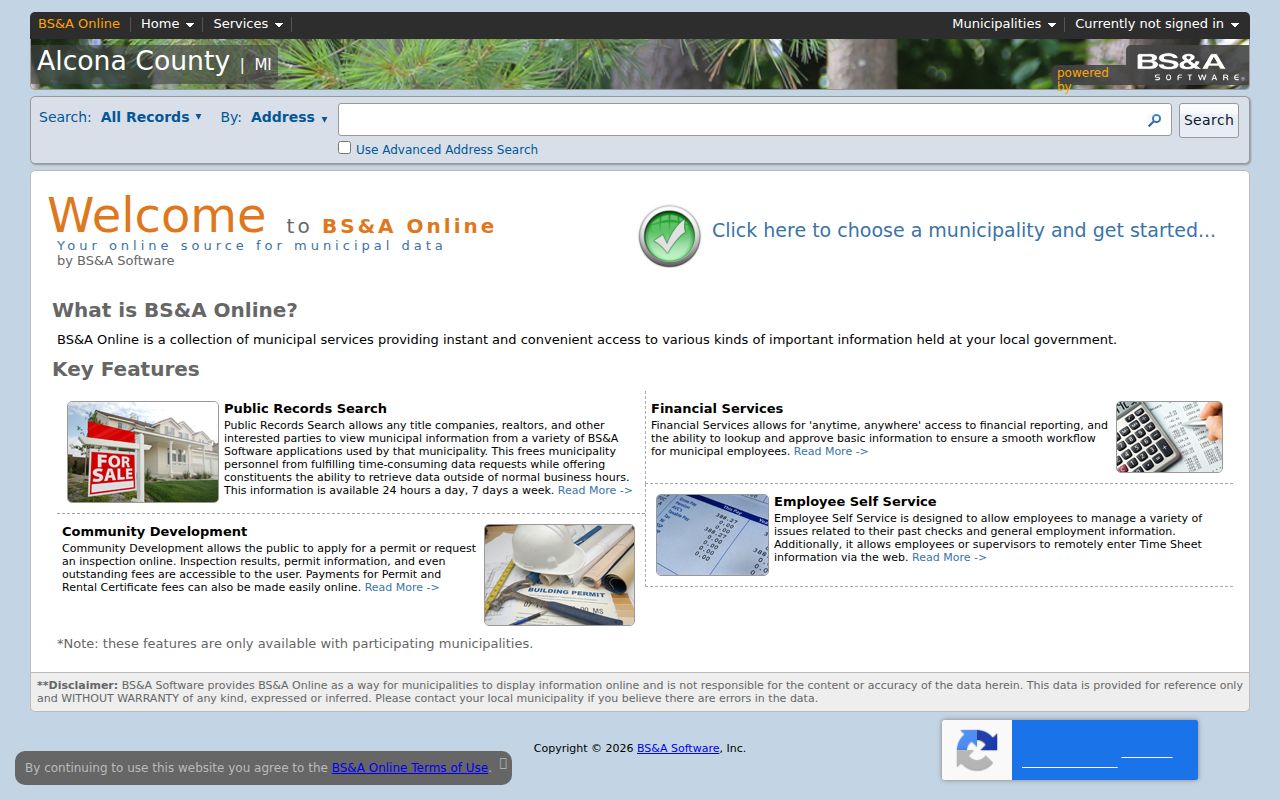
Assessing, current-tax, and delinquent-tax tasks each sit on their own tile. Choosing the record category and year before trusting a balance keeps an older amount from masquerading as the current bill.
Four Alcona County Value Labels That Must Stay Separate
Michigan assessment practice uses four related but noninterchangeable figures. Assessed value is the local estimate at roughly 50 percent of true cash value. State Equalized Value reflects equalization. Taxable value is the capped number actually used for taxation. Sale consideration belongs to the deed record, not the roll. A transfer generally uncaps taxable value in the following calendar year under Michigan Treasury transfer guidance. Statutory exceptions apply.
- Assessed value
- The assessor's annual valuation before equalization.
- State Equalized Value
- The equalized assessment, commonly abbreviated SEV.
- Taxable value
- The capped base to which millage is applied.
- Mill
- One dollar of tax for each $1,000 of taxable value.
No tax value or payment record proves legal ownership. For ownership questions, compare the Alcona County deed records instead.
Local Assessors and County Equalization Divide the Work
Alcona County splits assessment work between its townships and the City of Harrisville. Each parcel has a local assessor of record. The county's local assessor roster shows who handles which unit. The Equalization Department backs them up with assessment rolls, section maps, land values, property-search links, forms, and information requests.
Assignments shift over time. So before you mail an appeal or file an exemption document, confirm the current assessor for your parcel number. Sending paperwork to the wrong office only delays it.
The Equalization office sits at 106 5th Street, PO Box 322, in Harrisville. Call 989-724-9430 during weekday hours. Hours run 8:30 a.m. to 4:30 p.m., closed noon to 1 p.m. for lunch. The office also publishes an email route for information requests. An AllPaid link handles payments tied to them. When you reach out, name the tax year and the parcel number. State your preferred document format, and ask for a fee estimate.
PRE and Poverty Exemption Records in Alcona County
The Principal Residence Exemption can exempt up to 18 mills of local school operating tax. That benefit applies only to an eligible principal residence. It is not the Homestead Property Tax Credit. It is not evidence of title either. The Equalization form directory carries the PRE affidavit, conditional rescission, request to rescind, property-transfer affidavit, and qualified agricultural filing. It also holds the Board of Review petition.
Michigan's poverty exemption materials identify Forms 5737 and 5739. They also cover the required tax-return documentation. Form 5738 applies where a local policy uses another percentage. Under the state framework, a Board of Review may grant a reduction. The reduction can be 100, 75, 50, or 25 percent. The local assessor's current policy and filing calendar control the actual submission.
Note: Copy the exemption status and tax year exactly; an exemption affects taxation but does not transfer the deed.
Look Up an Alcona County Tax Bill Step by Step
Use the current and delinquent channels separately, so an old balance never gets mistaken for this year's bill.
- Search BS&A by the full situs address. If the street entry fails, use the parcel number or street-number range.
- Select Assessing or Current Tax and record the tax year, assessed value, taxable value, PRE status, charges, and payment status actually displayed.
- Use Delinquent Tax Search separately and confirm any balance with the Alcona County Treasurer.
- For a purchase or transfer, request a tax history and verify whether the parcel is merely delinquent, in forfeiture, in redemption, or scheduled for auction.
- Tax history
- A parcel-specific record of prior taxes and payment research maintained by the Treasurer.
- Delinquency
- An unpaid-tax status that must be dated and confirmed; it does not alone prove foreclosure.
- Tax lien
- A public claim for unpaid property tax, distinct from a deed conveying ownership.
- Public land auction
- A later stage in the statutory process, not a synonym for every late balance.
Alcona County Delinquent Taxes and Auction Status
The Treasurer wears several hats on delinquent property records. The office collects delinquent property taxes, mails delinquent notices, prepares tax histories, certifies warranty deeds, and runs the public-land-auction process once real estate is delinquent 2.5 years. Its page links BS&A delinquent payment, AllPaid, mail and drop-box options, and the state's public land auction site. The county publishes a credit-card fee of 3 percent.
Find the Treasurer at 106 5th Street, PO Box 158, Harrisville, telephone 989-724-9420, open weekdays 8:30 a.m. to noon and 1 to 4:30 p.m. Turnover dates move from year to year, so treat any listed status as a starting point. Ask which tax year is due, where the parcel stands in redemption or auction, and whether a later order or deed was recorded.
Do not infer a completed tax sale from delinquency. Confirm payment, forfeiture, redemption, auction, and any title-affecting instrument with the Treasurer and Register of Deeds.
Request an Alcona County Tax History Offline
The online record does not always deliver everything. Older years sometimes sit in paper files, and gated results hide detail. For a full Alcona County tax history, contact the Treasurer or Equalization. Reach the local assessor for assessment-roll material. Include the parcel number, situs address, owner of record if known, the years you need, and whether you want paper or electronic copies. Ask about research, copying, and mailing fees before placing the order.
A written request for an existing record can also proceed under the Michigan Freedom of Information Act, MCL 15.231 et seq. Public bodies generally respond within five business days. A written extension of up to ten more business days is allowed. FOIA does not force an office to build a new tax analysis. It also does not require an answer to a legal question.
The 2023 Equalization Count Adds Context
Scale matters when you work with Alcona County property tax records. The 2023 Equalization report counted 19,845 assessment parcels and units countywide. That figure is a roll count alone. It is not a population total. It is not a household count or a tally of separately marketable lots. It helps you gauge the size of the assessment system. It also lets you compare local-unit totals. A parcel-level Alcona County property tax record still does the real work.
Harrisville shows why the distinction matters. The report counted 460 city assessment parcels. The 2020 Census put the population at 437. Parcel totals sweep in exempt property, commercial entries, personal property, and multiple holdings. Keep the report-year label attached to every figure.
Appeal an Alcona County Assessment on the Local Calendar
Start local. The township or City of Harrisville assessor handles the first review. So examine the assessment notice and name the disputed field and year. Gather your evidence early. Comparable property records strengthen the case. Photographs help too, as does a recent appraisal when it applies. Papers correcting the parcel characteristics also matter. File through the county's assessment and Board of Review forms. Then follow the local notice for the filing method and session rules.
Appeal window. Dates are local and change. Harrisville's 2026 notice listed March 10 and March 12 appeal sessions, but owners must verify the current Board of Review notice before filing.
Harrisville also posted July 21 and December 16 sessions for 2026. An organizational meeting on March 3 heard no appeals. The meeting's purpose matters as much as its date. Township parcels answer to the responsible township's calendar, never the city schedule. Check dates against the current notice each year. The Alcona County assessment, PRE, and Board of Review form directory collects the filing paperwork in one place.
The Equalization form directory lists the current petition paperwork. The responsible local assessor's notice still controls the submission deadline and hearing procedure.